Harry S. Truman one of the most prominent figures in Jackson County
Published on May 06, 2026
Jackson County is celebrating its rich history during its Bicentennial in 2026.
One of the most prominent figures in the history of Jackson County is President Harry S. Truman.
As president, Truman made some of the most crucial decisions in history, including the dropping of atomic bombs on Hiroshima and Nagasaki, Japan, effectively ending World War II.
Harry S. Truman was born May 8, 1884, in Lamar, Missouri, the oldest child of John and Martha Truman. He was named for his maternal uncle, Harrison "Harry" Young. His middle initial, "S", is not an abbreviation of one particular name, it honors both his grandfathers, Anderson Shipp Truman and Solomon Young.
The family lived in Lamar until Harry was 10 months old, then they moved to a farm near Harrisonville. They next moved to Belton and in 1887 they moved to his grandparents’ farm in Grandview. When he was six, they moved to Independence.
After graduating from Independence High School in 1901, Truman took classes at Spalding’s Commercial College, a Kansas City business school. He studied bookkeeping, shorthand and typing but quit after one year.
In 1906 he returned to the Grandview farm, where he lived until entering the army in 1917. During World War I, he fought in France as a captain in the Field Artillery. Truman was awarded a World War I Victory Medal with two battle clasps and a Defensive Sector Clasp. He was also the recipient of two Armed Forces Reserve Medals. He remained active in the Officers’ Reserve Corps until the early 1940s.
Following the war Truman returned to Independence where he married Bess Wallace on June 28, 1919. The couple had one child, Mary Margaret Truman.
Shortly before his marriage, Harry and his friend Edward Jacobson opened a haberdashery in downtown Kansas City. After initial success, the store went bankrupt during the recession of 1921.
Truman was elected as County Court Judge of Jackson County’s eastern district in 1922. He was defeated in a reelection bid in 1924 but was elected as presiding judge in 1926 with the support of Tom Pendergast. As presiding judge, Truman helped coordinate the Ten Year Plan, which transformed Jackson County and the Kansas City skyline with new public works projects, including an extensive series of roads and construction of a new County Courthouse.
After serving as a county judge, Truman was elected U.S. Senator from Missouri defeating the Republican Roscoe Patterson in 1934 by nearly 20 percentage points in a wave of pro-New Deal Democrats elected during the Great Depression.
He remained in the Senate until President Franklin Roosevelt chose him as his running mate for his fourth term in 1944. He served as vice president for less than three months when Roosevelt unexpectedly died.
On April 12, 1945, Truman was sworn in as the 33rd President of the United States. He faced some of the most complex issues to ever face any world leader.
On his first full day, Truman told reporters, "Boys, if you ever pray, pray for me now. I don't know if you fellas ever had a load of hay fall on you, but when they told me what happened yesterday, I felt like the moon, the stars, and all the planets had fallen on me."
Following the dropping of the atomic bomb to end World War II, he faced the task of re-building both Europe and Japan and the changing of American foreign policy. The creation of the North Atlantic Treaty Organization (NATO), the Central Intelligence Agency (CIA) and National Security Council (NSC), the recognition of the State of Israel, the response to the Cold War and U.S. involvement in the Korean War were also decisions that Truman faced.
Truman was challenged domestically with labor unrest, the expansion of the GI bill for returning veterans, a proposal for national health care and the issuing of four civil rights executive orders.
The 1948 presidential election is remembered for Truman’s stunning come-from-behind victory. While campaigning for his first full term, he crisscrossed the United States by train. His “whistle stop” speeches from the rear of the presidential car came to represent his campaign.
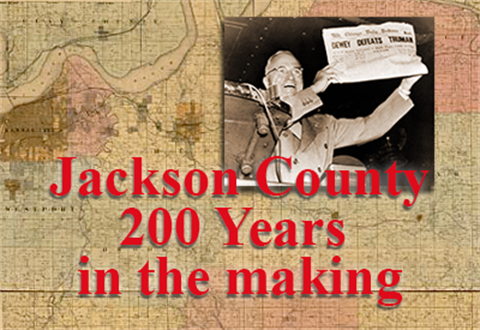
The defining image of the campaign came after the election when Truman held up the erroneous front page of the Chicago Tribune with a huge headline proclaiming “Dewey Defeats Truman.”
Upon leaving the presidency in 1953, Truman returned to Independence to live at the Wallace home, which he and Bess had shared for years with her mother. He focused on writing his memoirs and establishing the Harry S. Truman Library and Museum which opened in 1957.
He remained active in the Democratic Party, supporting candidates. Truman also taught occasional courses at universities including Yale.
He found time to relax enjoying his favorite bourbon with old friends, political allies and dignitaries who came through Independence. He famously walked roughly two miles around Independence every morning talking with visitors.
After a fall in his home in 1964, his physical condition declined. In 1965, President Lyndon B. Johnson signed the Medicare bill at the Harry S. Truman Presidential Library and Museum, giving the first two Medicare cards to Harry and Bess to honor the former president’s fight for government health care.
Truman died on December 26, 1972, at the age of 88 from organ failure following a severe case of pneumonia. He was buried in the courtyard of his presidential library. Bess died in 1982 and was buried next to her husband.